Utility Will-Serve Letters for Vacant Land: A Buyer’s Checklist
A utility will-serve letter says whether a provider is willing to serve a specific property and under what conditions. An availability letter may only identify nearby mains. Before buying a vacant lot, ask the water and sewer providers separately whether the documents cover your parcel and proposed use. Ask for a written fee breakdown before treating either document as a connection budget.
Which document should you ask for?
| What you need to decide | What to request | What to verify in the reply |
|---|---|---|
| Are there public mains I can potentially use? | Availability or service-area confirmation | Whether each service is available at the parcel and where the provider expects you to connect. |
| Will the utility serve the house I plan to build? | The provider’s will-serve letter or written service determination | Parcel number, proposed use, capacity or engineering conditions, and any further approvals. |
| How much money should I budget? | An itemized fee worksheet or extension estimate | Tap and capacity fees, meter, inspections, what has already been paid, and which work a private contractor bills. |
| What can I submit to close or apply for a permit? | The document your lender or permit office specifies | Required wording, issue date, validity on transfer, and whether another approval is needed later. |
Names vary by utility. Read what the letter confirms and what conditions it attaches. If you are unsure who serves the parcel, start with the water and sewer provider lookup guide. The city printed in a mailing address can differ from the utility’s service area.
Three real examples of the difference
- District of Columbia. DC Water’s availability letter identifies available mains. Its guidance explains that the letter does not establish capacity or permission to connect. It issues a separate certificate after project plans receive approval and applicable fees are paid. Ask the lender which document it wants if the request simply says “utility letter.” DC Water availability letter guidance.
- Arizona Water Company. The utility starts with a preliminary request. Its form asks for parcel numbers and whether the land will be split. The company describes its section maps as general reference, so use the parcel details for the written review. Arizona Water Company request form.
- Coachella Valley Water District, California. The district reviews development proposals for water and sewer capacity. Its will-serve process routes applicants to separate request forms. Get the evaluation for the actual development rather than relying on a map. Coachella Valley Water District service letters.
What to send the utility
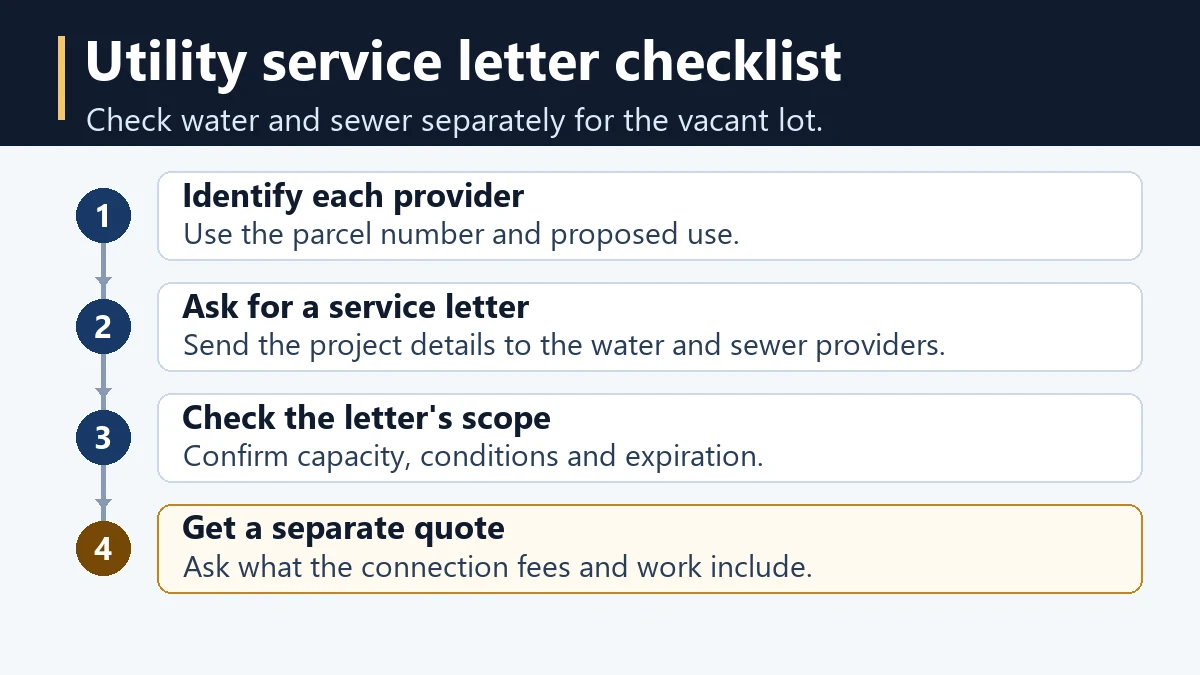
- Identify the land. Send the assessor’s parcel number, any assigned address, and a map marking the parcel. Use a separate request for multiple parcels if the provider requires it.
- Describe the proposed use. Give the number of homes, whether it is new construction or a replacement, and the requested water and sewer services. Mention additional units and fire sprinklers if planned. The provider can tell you which technical details it needs to determine capacity or sizing.
- Ask about existing connections and credits. Request written confirmation of any meter, usable tap or lateral, and previously paid charges the provider can verify. Ask whether a credit applies to the specific new project and transfers with the property.
- Ask where the public work ends. Mark the anticipated structure as well as the road frontage. Ask whether the provider expects a main extension, road crossing, easement, or a customer-installed line. Request an itemized estimate or the tariff section for the public work.
- Confirm timing. Ask when the letter will be issued, how long it is valid, and whether issuance, connection, or capacity depends on another approval or a fee payment.
For an example of a conditional reply, see Appendix D of the Washington State Department of Health Group B design guide. Its sample identifies the parcel and proposed development and makes final service subject to the application, required fees and plumbing standards. The form your utility issues may include different conditions.
A request you can adapt
I’m evaluating parcel [APN or address] for [one new single-family home]. Please confirm whether your utility can serve this parcel, where the connection would be, and what approvals or upgrades are required. Please indicate any existing tap, meter, lateral, or credit that applies to this proposal. My lender or permit office requests [document name]. Can you also send an itemized fee estimate and state how long the letter remains valid?
Attach a map and the smallest set of project information the provider requests. Keep the signed letter and the estimate together. A fee schedule and a dated quote can cover different scopes.
Worked example: water at the road, sewer across the street
Suppose the water provider says it will serve a single house from the frontage, while the sewer provider says the nearest main is across a paved road. You have two separate decisions. For water, ask whether the quote includes the meter and service from the main to the meter. Have a contractor price the private line from the meter to the planned house. For sewer, ask the provider where the connection will be approved and who must apply for road work and restoration.
Until the sewer provider confirms those conditions, leave the crossing as a separate budget item. Avoid applying a private-trench per-foot figure to the public road scope. Model the straightforward part in the utility connection cost calculator and compare the scope with the water and sewer connection guides. A local quote can then replace the applicable estimate.
Before you make a final decision
- Match the named utility, parcel, requested service and project on every letter.
- Record any condition that could require new capacity, an extension, or access across someone else’s land.
- Separate published connection charges, site-specific quotes, and contractor work.
- Send the actual document to whoever requested it, and confirm that version is acceptable for the transaction or application.
For the wider budget, continue with what it costs to bring utilities to vacant land and the city tap-fee comparison.